NavKar Systems
SB-10 Single Beam Sensor 10 Meter | Single Photoelectric Detector Active IR Alarm Host for Security System (Pack of 3)
SB-10 Single Beam Sensor 10 Meter | Single Photoelectric Detector Active IR Alarm Host for Security System (Pack of 3)
Couldn't load pickup availability
SB-10 Single Beam Sensor 10 Meter
- Buy on Amazon: CLICK HERE TO BUY ON AMAZON
Product Overview
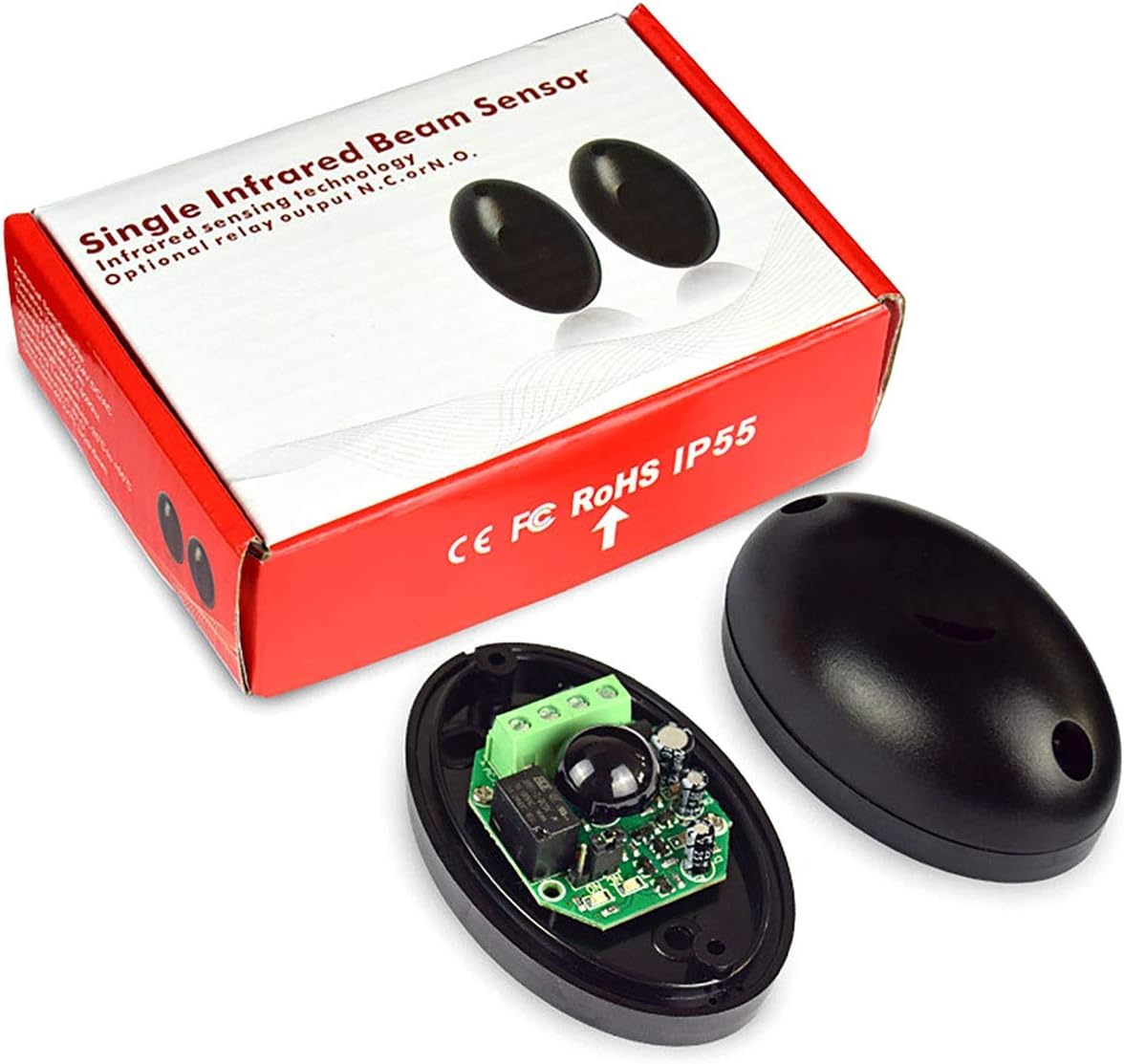
The SB-10 Single Beam Sensor 10 Meter is an active infrared photoelectric detector designed for automatic doors, security systems, access control, gates, barriers, and industrial equipment. It consists of a transmitter and receiver that create an invisible infrared beam between them. When a person, vehicle, or object interrupts the beam, the receiver detects the interruption and activates its output for the connected control system.
The sensor operates on a 12–24V DC power supply and provides a fast response time of approximately 30 ms. With a 940 nm infrared wavelength and IP55-rated housing, it is designed for reliable operation in suitable indoor and outdoor environments. Its weather-resistant construction helps protect the sensor from dust and rain, while proper alignment ensures stable beam detection.
Main Purpose
- Detect people, vehicles, or objects by interrupting an infrared beam.
- Provide a detection signal to compatible door, gate, alarm, or access-control systems.
- Support automated opening, closing, safety, and security applications.
Key Benefits
- Reliable infrared beam detection without physical contact.
- Up to 15 m detection range for effective monitoring of entrances, gates, barriers, and security areas.
- Fast approximately 30 ms response for quick detection.
- 12–24V DC operation for compatibility with common control systems.
- IP55 weather-resistant housing for suitable indoor and outdoor installations.
- Compact PC construction designed for practical installation.
- Relay output for connection to compatible automation and security equipment.
Important Features
- Single-beam active infrared technology
- Separate transmitter and receiver
- 940 nm infrared wavelength
- 1.92 kHz operating frequency
- 30 ms induction/response speed
- IP55 protection
- 12–24V DC operating voltage
- Automatic door and gate compatibility
- Suitable for security and industrial applications
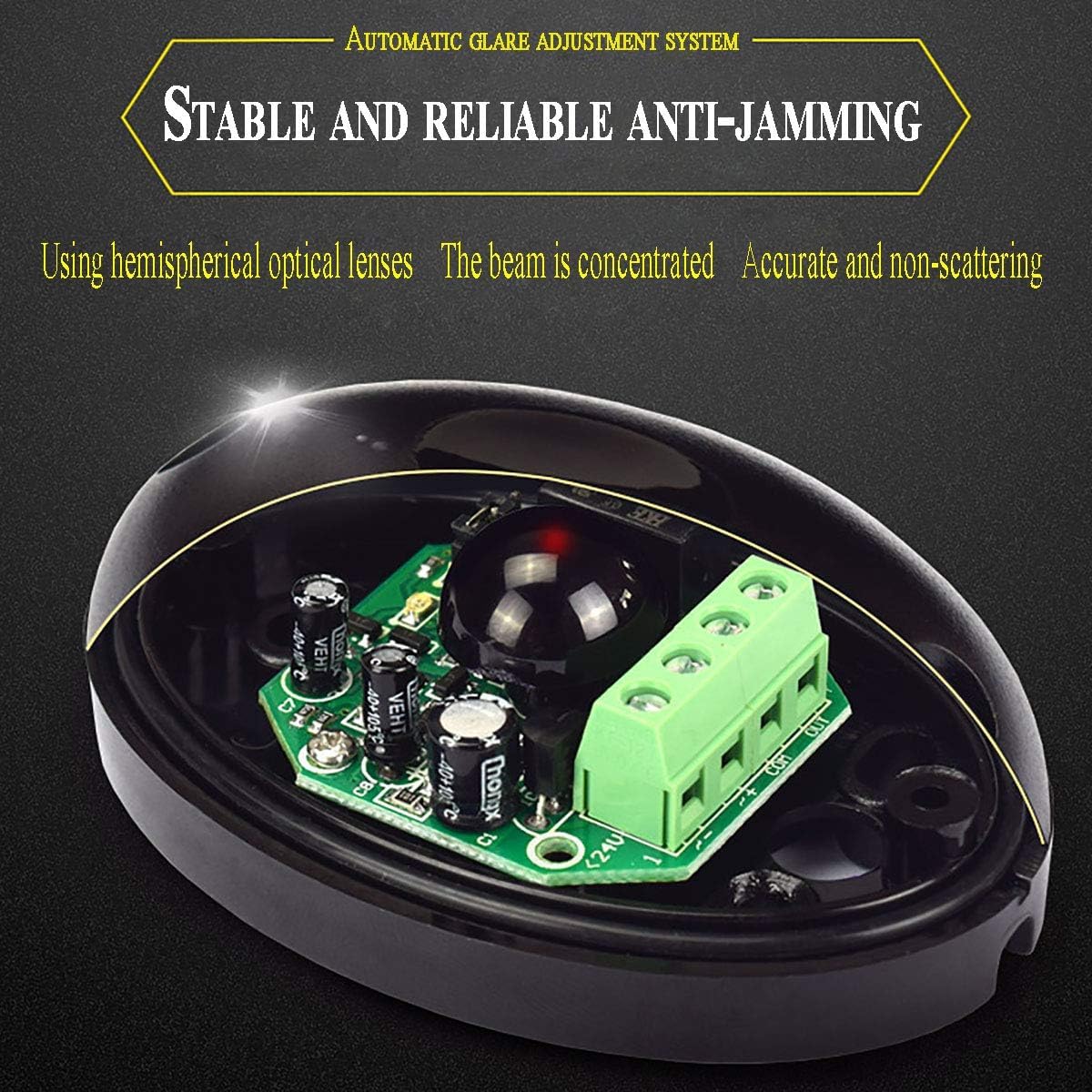
- Anti-jamming/anti-interference design
Product Specifications
Model: SB-10
Product Type: 10 Single Beam Sensor 10 Meter | Single Photoelectric Detector Active IR Alarm Host for Security System
Brand: Navkar Systems
Power Supply: 12-24V DC
Communication: Wired
Operating Range: Upto 15 meters
Material: PC(Polycarbonate)
Dimensions: 12.4D x 8.6W x 3.6H Centimeters
Other Specifications: 940 nm infrared wavelength, 1.92 kHz frequency, approximately 30 ms response speed, IP55 protection, transmitter and receiver configuration, relay output, suitable for automatic doors, gates, barriers, security systems, and industrial applications.
Applications
Suitable For
- Suitable Application: Automatic doors, gates, barriers, access control systems, security alarms, and industrial safety systems.
- Suitable Environment: Offices, factories, warehouses, commercial buildings, residential properties, and suitable outdoor areas.
- Suitable Installation: Wall or surface-mounted installation where the transmitter and receiver have a clear line of sight and can be accurately aligned.
- Suitable Users: Security system installers, access control professionals, gate automation technicians, and commercial/industrial users.
- Suitable Detection: Monitoring the movement of people, vehicles, or objects by detecting interruption of the infrared beam.
Not Suitable For
- Not Suitable Application: Applications requiring detection beyond the 15-meter operating range.
- Not Suitable Environment: Locations with severe weather conditions such as heavy fog, intense rain, or excessive dust, which may reduce infrared detection performance.
- Not Suitable Installation: Locations where the transmitter and receiver cannot maintain a clear and properly aligned infrared beam.
- Not Suitable Power Supply: Systems that do not provide the required 12–24V DC power supply.
- Important Limitation: Not suitable for directly switching electrical loads that exceed the sensor's specified relay/contact capacity.
- Environmental Limitation: Although the sensor has IP55 protection, it should not be treated as fully waterproof or submerged in water.
Package Contents
- 1 × SB-10 Infrared Transmitter
- 1 × SB-10 Infrared Receiver
- Mounting Screws & Accessories – As supplied with the product
- User / Installation Manual – If included in the package
Installation
Step 1 – Select the Installation Position
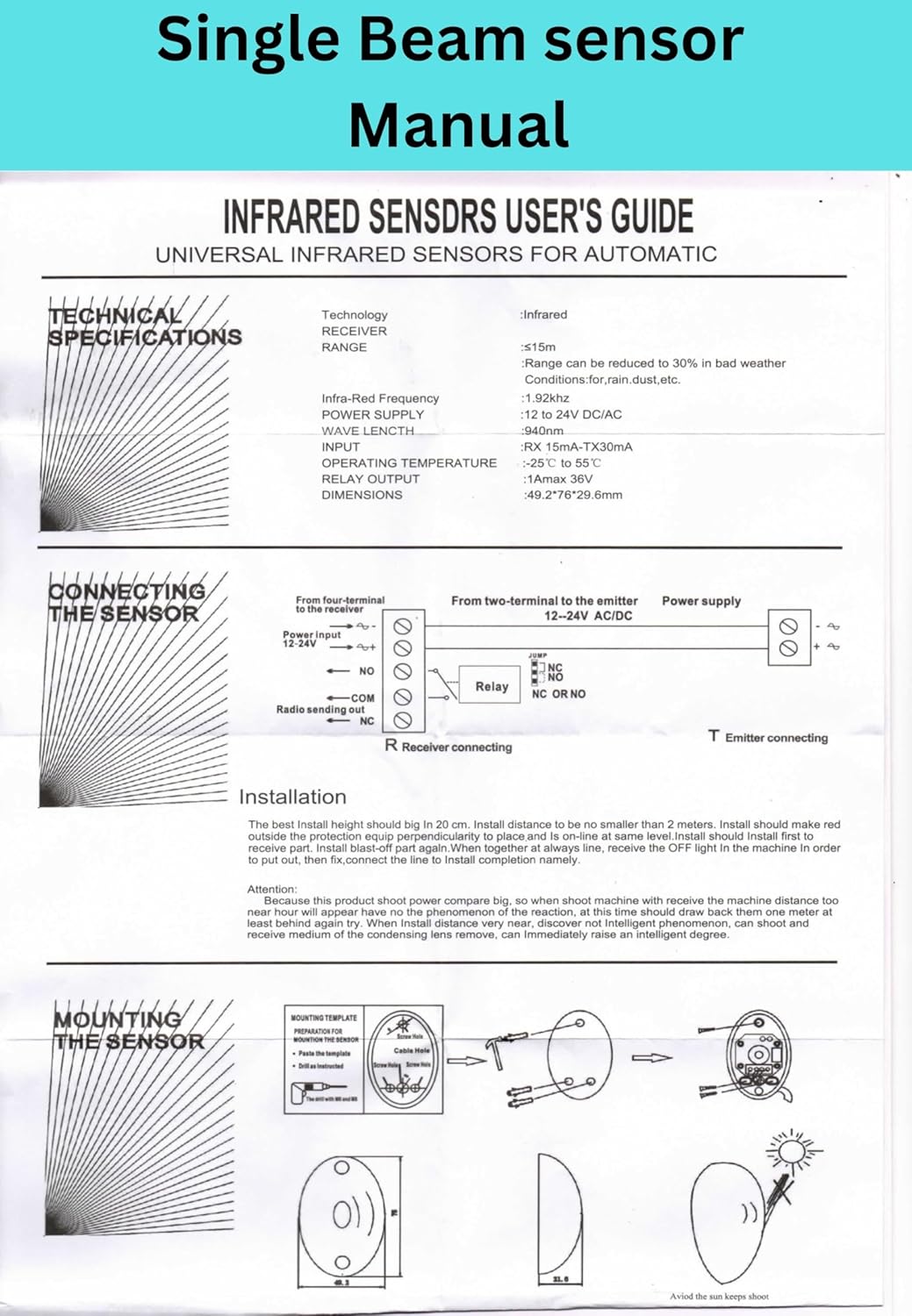
Select a suitable location for the transmitter and receiver. The manual recommends an installation distance of at least 2 meters between the transmitter and receiver.
Step 2 – Maintain Correct Alignment
Install the transmitter and receiver at the same height and on the same horizontal line. The transmitter and receiver should face each other directly so that the infrared beam can travel correctly between them.
Step 3 – Avoid Direct Sunlight
Install the sensor in a position where direct sunlight does not shine into the receiver lens, as strong sunlight may interfere with infrared beam detection.
Step 4 – Prepare the Mounting Holes
Use the supplied mounting template to mark the required screw holes and cable hole on the installation surface. Drill the holes according to the mounting template.
Step 5 – Mount the Sensor Housing
Secure the sensor base firmly to the mounting surface using suitable screws and wall plugs. Pass the required cables through the cable opening.
Step 6 – Install the Internal Sensor Assembly
Position and secure the sensor assembly inside the housing, then connect the wiring according to the terminal connections shown in the manual.
Step 7 – Align and Test the Beam
Power the transmitter and receiver and adjust their positions until the infrared beam is correctly received. Confirm that the receiver indicates normal beam reception before permanently tightening the mounting screws.
Important: Keep the transmitter and receiver stable after alignment. Movement of either unit can cause incorrect or intermittent detection.
Wiring
The SB-10 Single Beam Sensor uses a wired connection between the transmitter, receiver, power supply, and the connected control system. Connect all terminals according to the markings provided on the sensor and the applicable wiring diagram.
Power: Connect a 12–24V DC power supply to the designated power terminals of the transmitter and receiver, observing the correct polarity.
Input: The receiver receives the infrared beam transmitted by the transmitter. Ensure both units are correctly aligned and have a clear line of sight.
Output: Connect the receiver's relay output to the compatible input of an automatic door controller, gate/barrier controller, alarm panel, or access-control system. Use the appropriate COM, NO, or NC contact according to the controller's requirements.
Other Connections: Keep the transmitter and receiver properly aligned and use suitable wiring for the installation. Avoid routing sensor wiring alongside high-voltage or high-interference cables where possible.
Programming
The SB-10 does not require software programming. According to the manual, configuration is performed through physical installation, beam alignment, wiring, and the NO/NC relay jumper.
Step 1 – Power the Sensor
Connect the receiver and transmitter to their required 12–24V power supply.
Step 2 – Align the Transmitter and Receiver
Position the transmitter and receiver directly opposite each other and at the same height. Adjust them until the receiver continuously receives the infrared beam.
Step 3 – Select NO or NC Output
Use the jumper provided on the receiver PCB to select the required relay output:
- NO – Normally Open
- NC – Normally Closed
Select the position that matches the input requirement of the connected door, gate, alarm, or access-control controller.
Step 4 – Test the Beam
After alignment, interrupt the infrared beam by placing an object between the transmitter and receiver. Check that the receiver changes its relay/output state.
Step 5 – Connect to the External Controller
Once the sensor operates correctly, connect the receiver's COM and output terminals to the compatible control equipment and test the complete system.
Step 6 – Secure the Installation
After successful testing, tighten the mounting screws and ensure that neither the transmitter nor receiver can move out of alignment.
Operation
Step 1 – Power On
Supply the transmitter and receiver with the required 12–24V power. The transmitter begins emitting an infrared beam toward the receiver.
Step 2 – Normal Beam Detection
When the transmitter and receiver are correctly aligned, the receiver continuously detects the infrared beam and remains in its normal operating state.
Step 3 – Beam Interruption
When a person, vehicle, door, gate, or other object passes through and breaks the infrared beam, the receiver detects the interruption.
Step 4 – Relay Output Activation
When the beam is interrupted, the receiver changes its relay output state according to the selected NO (Normally Open) or NC (Normally Closed) configuration.
Step 5 – Connected Equipment Responds
The relay signal is sent to the connected automatic door, gate, barrier, alarm, or access-control system, which performs the action configured on that equipment.
Step 6 – Beam Restored
When the obstruction moves away and the infrared beam is restored, the receiver returns to its normal detection state and the relay output changes accordingly.
Troubleshooting
Spare Parts
- SB-10 Transmitter Unit – Replacement transmitter for the single-beam infrared sensor.
- SB-10 Receiver Unit – Replacement receiver unit for detecting interruption of the infrared beam.
- Mounting Brackets & Screws – Replacement mounting hardware for installation and alignment.
Spare parts are provided separately, subject to availability.
Warranty
The SB-10 Single Beam Sensor is covered by a 1-year warranty against manufacturing defects under normal and proper use. The warranty covers defects related to the product's original manufacturing and functionality.
The warranty does not cover damage caused by improper installation, incorrect wiring, power fluctuations, physical damage, water or moisture exposure, misuse, unauthorized modification, or normal wear and tear.
Videos
Manuals
User Manual:

Downloads
- [Datasheet] : NA
- [Wiring Diagram]: NA
- [Catalogue / Brochure]: NA
- [Other Download]: NA
Customer Questions
-
Q: What is the SB-10 Single Beam Sensor used for?
A: It is designed to detect movement or intrusion by creating an active infrared beam between the transmitter and receiver. -
Q: What is the detection range of the SB-10?
A: The SB-10 is designed for a 10-metre detection distance when the transmitter and receiver are correctly aligned. -
Q: Can the SB-10 be used with a security alarm system?
A: Yes. It can be connected to a compatible security alarm host/control panel to trigger an alarm when the infrared beam is interrupted. -
Q: Is the SB-10 wireless?
A: No. The sensor uses wired connections for power and alarm output. -
Q: What does a single-beam sensor detect?
A: It detects an interruption of the infrared beam between the transmitter and receiver, which can indicate movement through the protected area. -
Q: Where can the SB-10 be installed?
A: It can be used for suitable doors, gates, entrances, pathways, corridors, and restricted areas where a 10-metre detection path can be maintained. -
Q: How many sensors are included in this package?
A: This listing is for a Pack of 3 SB-10 Single Beam Sensors. -
Q: Does the SB-10 provide video surveillance?
A: No. It is an active infrared detection sensor and does not provide video recording or image monitoring.
Escalation to Support
If the issue cannot be resolved using the information above, Please contact Navkar Systems at Whatsapp Support number: 91384 68548 with the following information:
Product Model:
Purchase Date:
Problem Description:
Installation Details:
Photos / Videos:
Previous Troubleshooting Performed: i want the details of this product in this format